I have a great many interests. Among them is writing poetry, taking photo's, the practice of T M and following a druid like path. What I am not nor have I ever been is subservient or fanatical. In the true sense of the term I am a free thinking person.


The doldrums is a nautical term for an area of the ocean where the air rises and there is no wind, the term was coined by the seafarers of sailing ships. Therefore to be in the doldrums is an expression of having no movement and that is where myself and Mrs Heron are today.
The builders are due soon, firstly to erect scaffolding and then to put a new roof on this bijou cottage, not a big job. We are also to have new windows and a draught proof front door. Which I will enjoy for the last few winters, when the winds were from the north east, I sat with a rug around my head and shoulders. Fortunately we only get the wind from that direction a few days of the year.
In the meantime we have been doing some research on how long this place has had an iron roof. We used the on-line Census for 1901, identified our place and how may people lived here plus their names of course. In those times it had a thatched roof above stone walls and then we visited the 1911 Census to discover that the thatch had been replaced with corrugated iron and a different family was installed.
Which means for approximately 100 years it has remained with the same type of roof covering.
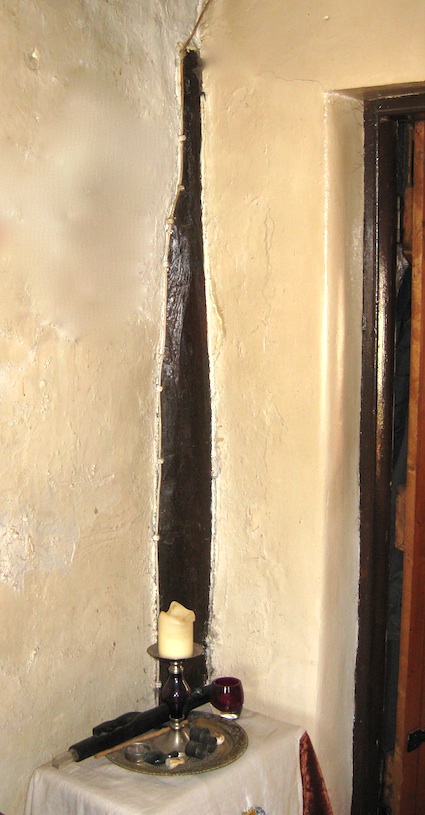
There are two distinct features inside the front room, called here in Ireland the kitchen. One is the wooden post in the corner, through which a ley line passes. I was told this post was the remains of a faery tree that was built into the cottage rather run the risk of cutting it down and receiving bad luck. The other feature which can be found in traditionally built cottages (modernly described as 'vernacular architecture') is the sleeping shelf above the front door. Up there would have slept the passing stranger or traveller. The shelf is approximately 6 feet long x about 20 inches high x 30 inches wide, suitable for a rather slimly built person !
Today it is a hideaway for odds and ends. The jug-like container in the foreground is yet another product of the Tinker, just as was the copper scuttles in an earlier blog.
The original building had two rooms: a sleeping room for the parents and the kitchen, which was fitted with settle beds that closed up in the mornings to provide bench like seating. In this confined space, a family of 6 children and their parents lived. It was from one of the sons of the family that I bought this cottage. By then an extra room had been added at the rear and I added more. I also dowsed and found a source of water within a few feet of the rear wall, a bore hole was drilled and water was brought into the cottage from the well by an electric pump.
The previous owner came visiting as soon as all facilities were connected and to him I gave the honour of using every item in the bathroom. He sat with me when I lit the stove and kept touching the pipes from the back boiler to feel the gradual heat that was emanating from them, as hot water flowed into the copper cylinder situated in the hot press. The year was 1991 and eighty years on from when his parents first moved in.
It is very hard now to imagine the privations that the family went through during the course of their lives here, such as walking a quarter of mile down the road to the communal well in all winds and weathers frequently throughout the day and every day of the year.
This is a cosy warm home in the winter and a cool one on hot summer days. Strangely when it rains it is not as noisy as you might imagine and when it snows there comes a soft swishing noise. It can be though quite worrying in high winds, for there is always a fear of a sheet of iron breaking loose and letting the rain enter through our wooden ceilings. All of these things we will miss and that is sometimes the price of modernization, in that we cut ourselves off from the natural world.
From the middle of May to July or even later the cutting and saving of the turf starts. It is an annual ritual for a lot of families in rural Ireland today, even though other fuels are used such as oil, coal and electricity. It is turf that is still the main fuel in the countryside and the rural towns.


Several years ago an incident occurred at my home whilst I was three counties away on a sunny afternoon enjoying myself in the company of friends. Immediately on returning home I realized that all was not as I had left it.
For the back door was wide open, because robbers had forced their way into my home and every room had been disturbed, the bedroom was in complete and utter disarray.
I was numb with shock not really knowing what to do next, my first action was a 999 call to the Garda (Police) I then slowly took stock of the situation to see what was missing and what had been damaged.
The greatest loss/hurt was not monetary. It was the bald fact that my home and inner sanctum had been invaded by strangers, my privacy taken from me. My emotions were in turmoil as I went from anger to disappointment, to anger combined with sadness, to outrage. Finally I came through the storm to recover the status quo.
The experience enriched my senses for it gave me a small measure of what it must be like on a larger scale to have your home - country in a state of oppression and invaded by a foreign power.
Thus I have been feeling rather distraught and angry this week, after reading about the unnecessary deaths and injured activists that were on the Humanitarian Aid ship Mavi Marmara 130 miles off the coast Israel, in international waters.
This was an act of piracy and willful murder by Israel. The Somali fishermen are also conducting acts of piracy. To whit an international force is patrolling those waters in order to protect shipping. As I write this blog another humanitarian aid ship the Rachel Corrie is steaming towards Gaza with supplies - will it's activists too become victims ?
[Rachel Corrie you may recall was a 23 yr old American activist who was murdered by an Israeli Army bulldozer in 2003]
This madness, this sick disregard for human lives, the propaganda machine and aggressive military machinations of Israel have been continuously funded by the USA for dozens of years, costing them trillions of dollars.
All it takes is for one brave phone call from the President of the USA to put a Stop to this insanity!


This sunny Sunday I decided to go on a solitary walk, away from the tarmac and on to the old roads used these days by the farmers and their cattle. Walking speed is reduced to an amble once you leave the council road. It suited my purpose, giving time to listen and enjoy the surroundings; as well as to think.
I noticed cows with calves in one field taking shelter from the hot sun and a large bull looking benign, standing quietly in his paddock on the opposite side of the road. I raised my camera and asked him to look at me 'I want to see the whole of your face please ?' and he turned his great head remaining in pose until I said 'Thank you'.
My route led me to one of this land's three sister rivers The River Barrow, the other two are the Nore and the Suir which rise within a few miles of each other, to meander through familiar named places and join as one great river that flows into the sea at Waterford. The Barrow, perhaps named after the goddess Berba, runs a few hundred metres to the rear of our home, to a place where it is both narrow and shallow, providing a ford for sturdy tractors. The banks are about 3 metres above the rivers' summer level and a footstick leaps the gap.
Here at the ford I stopped. It is truly our nearest sandy beach, one that on quiet summer afternoons when I lived alone, I would visit with a book, my pipe, a bottle of wine to while away time in peace and in perfect harmony with nature. Today I sat for a while and listened to the babbling Barrow as it flowed over stones. The sound isn't constant, it has a rhythmic sequence. It was to rivers such as these that
the bardic-filidh came to compose their poetry and to travel in a shamanic way.
As I looked at the shallows there was a shoal of pinkeens, or you might call them tiddlers or fry, they were darting in and out of the shallows, I was very conscious that it was the vibration from my movement on the bank that made them quite so active and so I stood still as possible to get the best photo of them.
From across the other side of the river, there came the sound of a cow pumping water. ref www.riferam.com/pasture/index.htm
She was a brown cow one of those with baleful eyes, as she finished drinking and came near me, I asked her to come closer to fill the lens and she did. Following this I tuned and ambled along only to see a smallish animal running towards me, at first I thought it might have been a hungry fox, then I realized it was a hare and by the time I had the camera up it had disappeared from sight. Similar thing happened with a field of sunbathing rabbits, that as soon as I stepped closer they all bolted. Perhaps I could have a camera attached to my hat so that the raising of an eyebrow takes a snap; I am able to raise one higher than the other just in case you are wondering.


I get an earthy sense of May or Bealtainne, as it is in Irish Gaelic, a few days before the start of the month, a quickening or enlivening of the inner self, so much so that I understand what is meant in the old poem about 'the merry month of May'. For yes, I feel Merry and slightly Loopy - actually it is with me now as I write this blog :-)
There are many folk traditions throughout Ireland and indeed Europe to do with the this month, too many for me to do them justice. Locally in the mountains the Maybush is still decorated with rags, ribbons and egg shells and some people get up early in the morning to wash their face and hands in the dew.
The swallows have returned though there are few near us, so I am wondering whether this is may be a portend for bad weather. I did see a huge amount of them on the West coast the other week and I heard a Cuckoo there too and I have yet to hear one near us this year.
I have been rather busy this last week assisting Mrs Heron rearranging and redecorating the roost (bedroom) The colour she chose is I am told Ashes of Roses, though to me it is a sort of lilac-pink, which I find amusing because it is similar to what it once was before herself deigned to migrate from Brighton (UK) to join me on this sacred island. As they say here 'What goes round comes round' and that is true.
Being a simple male little did I realize at the time I agreed to assist, that it was not going to be just a paint job or that it would entail the purchase of new curtains, bed-coverings, a chest of drawers and a decorative cushion solely to catch the light! To be honest though it does look and feel rather more comfortable than it did. I think this transition has much to do with the change of energies it being Bealtainne.


Cool Atlantic waters, tranquil, flood, surround
seaborne stone that glows in golden light,
A caress from Sun, a gift, a gentle kiss, a farewell.
For night is soon to birth.

All the world has heard of Connemara, a very special area in Co. Galway and it was to Carna, a small coastal village, that we headed off to early on Saturday morning for Carna's Sean Nós Festival and to visit friends. The journey of 3 hours was eased by using the motorway, which I generally try to avoid because they are so boring, my preference is for the quieter and more scenic type of road.
Many are the families that have lived long in Connemara, of who's sons & daughters have travelled out of this land to settle in every part of the world.
One in particular is Seosamh O hEanai (Joe Heaney) 1919 - 1984 a native of Carna, who spent much of his life living in England, Scotland and New York. Heaney was an artist-in-residence at the University of Washington in Seattle. The Joe Heaney Collection of the University of Washington Ethnomusicology Archives was established after Heaney's death in 1984. The Féile Chomórtha Seosamh O hEanai (Joe Heaney Commemorative Festival) is held every year in Carna.
In the pub where the Sean Nós singing was taking place, all attention was given to the singers, even pints of the black milk are left on the bar, customers stand with their backs to the counter and no conversation takes place, that is apart from the necessary hushed whisper to order another pint from the barman.
The long melodic notes of the singers in gaelic tongue, fit in very well with this land they suit the skies, the special quality light that landscape painters thirst for, the rolling fogs and the long waves that sweep the shore. Their songs and clarity of voice sweep before them conjuring images in the listeners minds, to such an extent that it matters not a jot whether you understand the language.
I feel that it would be remiss of me to ignore another family, who promote their Gaelic culture by contributing to the arts of literature, song and music, the Mac Con Iomaires.
www.youtube.com/watch?v=e4pUOpdgTWM&feature=related
www.youtube.com/watch?v=MF2CfAjwcAs&feature=related
Colm & Darrach Mac Con Iomaire & Frank Tate - 'Frailach' & gan ...