Showing posts with label citizens. Show all posts

Thursday, 23 November 2017

A Watery Awakening!

Tuesday night was not one of my best for sleep was hard to find. I was wearing one of those blood pressure cuffs that inflated every hour during the night and every half an hour in the day time, It was damnably annoying for I was awoken each time. From my bed I could hear extremely heavy rain falling in torrents, making a drumming noise that only storms do.


So it was of no real surprise to find a pond in our road the following morning. The roadside drain had been supposedly cleared by a contractor who specialises in such things, though some only do the minimum of work and of cosmetic appearance only. The six-inch ceramic pipe which actually carries away the water to a lower level was still blocked and the reliance on seepage only, had created the pond.


A pond covering our southerly entrance.


I had an appointment with the doctor at 10.30am, just a few miles away, no more than a 5 km drive. We took our normal route and were flagged down by a man in a van so Mrs H slowed down to a crawl and just as well that she did for a round the corner a powerful muddy torrent several millimetres deep was crossing the road. Further along we could see a vehicle that had ben swept into the ditch.


Water from the river Barrow over flows fields and roads


The Barrow water flows on...

The impassable state left us no alternative than to return and try another route via the nearby village of Rosenallis. Our journey this time progressed quite well, although there was some ponding that had to be negotiated with care, it was safe enough, until we approached Tinnahinch bridge. There we were met by yet another raging, muddy flow from the river Barrow which had taken charge of the road, forcing us back to Rosenallis.


Tinnahinch Bridge

A hardy Donkey bathes its feet


Trees sucked from the riverbank block the flow 
of a normally tranquil river


On the other side of  Tinnahinch bridge

Our only alternative now was to drive to Killiegh in Co Offaly, along a road that borders the Clodiagh river whose banks are quite high. I felt this would be our only route to the Doctors even though it was miles out of our way. 
It was the right decision as we only met with one small over flow from the embankment and several small road pondings en route.
Finally the damn gadget was removed from my left bicep and the results were given to me. 

At Clonaslee

The Clodiagh River it too misbehaved
making a nuisance of it's self.
Unlike the River Barrow which joins the sea at
Waterford, the Clodiagh travels into Co. Ofally and eventually
flows into the River Shannon to join the sea south of Limerick.


The Clodiagh in full flow northwards to Ofally


Near me the flooded pasture of a neighbour.

Back at home. When a few hours later, a friend arrived in his jeep and we went off exploring to take photos of our earlier watery obstructions. Today, Thursday 80 percent of the floods have drained away.
Have you any experiences of being flooded or have a similar journey to ours ?

The waters flowed into Mountmellick a town of about 5,000 people


Saturday, 29 July 2017

Church of the Sloes

We took a train to Killarney a few days ago. It was a most enjoyable journey that passed through delightful scenery, lush green fields, distant mountains and of course the Paps of Anu which always catch our attention. 

The Paps held a significance.
Part of the reason for our journey was to visit an historian who has kept these mountains in his focus and in the public eye for over seventy years. Being an author of dozens of articles that have been read in almost every Irish publication, he is a well known figure in Kerry. 

Today Dan Cronin, a native of Rathmore, near Killarney, who, at the age of ninety-seven has not yet retired his pen, told us that there are still a couple more articles that he intends to write.


Do you know this elegant person ?


KILLARNEY RAIL STATION


Two Stags Rutting
This particular pair have a stainless steel skeleton 
with bronze sheathing and cost €70,000.


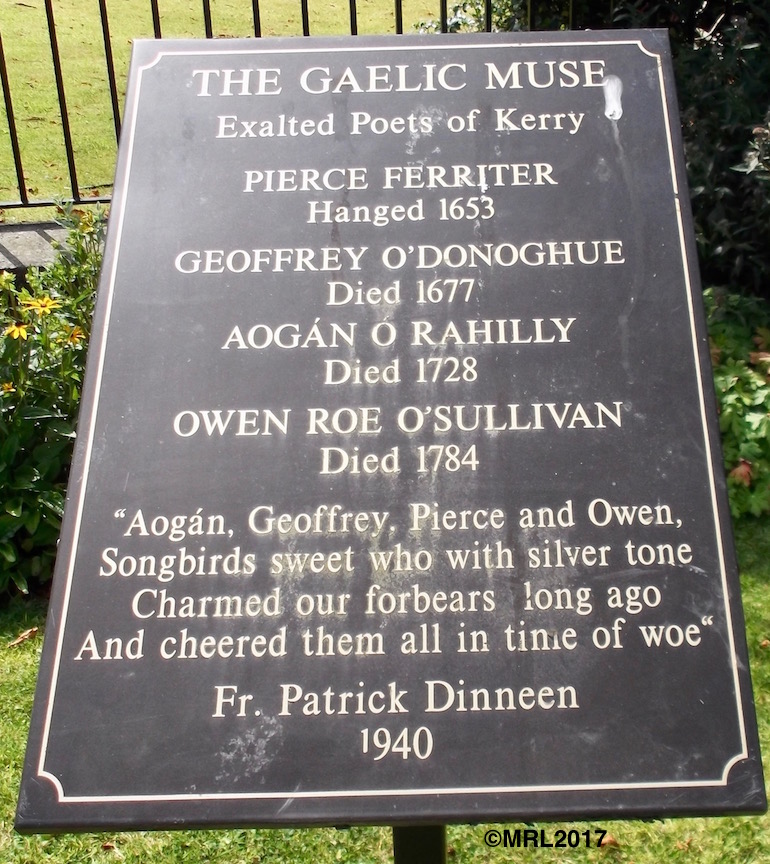
The Gaelic Muse


New use for a phone box stood next
too a representation of a White Tailed Eagle
The Eagle who resides in Killarney Town Centre was commissioned by a sub group of Killarney Town Council, the Killarney Arts Committee, in 2008/2009. The sculpture, a local artist Joe Neeson, initiated the concept from design to creation which represents the Killarney connection with the White Tailed Eagle. During that time the White Tailed Eagle project was well underway which saw the Eagle reintroduced to Killarney National Park.


Murphy's Ice Cream Parlour http://murphysicecream.ie/about-us.html


The second reason for the visit was to ramble around the town with our cameras and to enjoy ourselves by window shopping. That was the plan until we saw that there was a large branch of TK MAXX in the High Street and our resolve not to shop crumbled in milli-seconds !

We finally treated ourselves to one garment each and departed with a spring in our step to a small cafe for lunch. 

This was followed by a delicious ice-cream from Murphy’s of Dingle whose slogan is “ice cream that know’s where it’s coming from”


A lovely mural in one of the dining rooms of a unknown café where we had a wonderful lunch of a large toasted flatbread with a Cheese, Tuna and Sweetcornfilling and because of our hunger we failed to note the name of the café!

The Paps of Anu

There was a lot more to see and explore in Killarney whose name translates as Cill Áirne, meaning Church of the Sloes. 
We shall return again later in the year, when hopefully the streets will be less busy, for we country mice are not comfortable in crowds. 
I am making promise to myself to treat Mrs H to a ride in one of those famous jaunting cars on our next visit and perhaps another ice-cream will be in order.


Where shall we visit next do you have any suggestions ?


Friday, 21 July 2017

GALWAY continued.

After we had had our lunch in Galway my desire was to visit Spanish Arch which I had heard much about over the years and never visited. Or so I thought.

Before making our way to Spanish Arch I spied the hull of a large vessel in the distance. Well, as  most of you probably know I am attracted by almost anything that floats and so I just had to take a detour and see what was what.

The Galway City Dock

A small tanker but large enough.

An Irish Customs patrol boat.


The photographer receives a salute - it must have been my
bushy beard !

Spanish Arch

 On arriving there it dawned on me that I was standing besides the Galway Museum, which we had visited a couple of years ago and I had never noticed the arch !

The Spanish Arch was built in 1584, originally as an extension of the city walls and designed to protect the quays. The name is in fact a misnomer, as there is no proven association between the Spanish in Galway and the building of the Arch. In the past it was known as The Blind Arch and is located on the site more appropriately known as Ceann na Bhalla (The Head of the Wall).


I took a liking to this cheery fellow.


Across the fast flowing River Corrib is the ancient settlement of Cladach

Across the river from the Spanish Arch sits the ancient settlement of Cladach, meaning ‘stony shore’, or as it is now known Claddagh. The area above the shore where the Corrib River meets Galway Bay, was once home to Galway fishermen and their families. 

Located just outside of the Town of the Tribes (as Galway is known), the settlement dates back to AD 500, one of the oldest fishing towns in Ireland. 


Old Cladach

Due to severe out break of TB among the inhabitants in 1927 the old unhealthy thatched cottages of the Claddagh were demolished in the 1930s.  Council houses and other more modern homes replaced them yet the memory of the small Irish-speaking town's traditions and customs still live on. 

Despite its close proximity to Galway city, Claddagh remained a completely separate entity for centuries because of the wall surrounding Galway which kept a divide between this village and the Anglo-Norman city across the river. The community also had it’s own King who was elected annually, today it is an honorary title.


With the sole rights to fish in Galway Bay, the Claddagh fishermen thrived and their fresh catches were sold by the Claddagh women at Spanish Arch and at other places thought the city. It is believed that by the early 19th century, there were as many as 820 fishermen in the village who ran around 80 boats. 

The wives of the Claddagh fisher men


A Claddagh (Galway) Hooker
In boats such as these the Claddagh men would have earned their living.


The sound wobbles a bit during one part of the recording 
and then comes good, so don’t switch off.


Monday, 12 June 2017

IRELAND'S LITTLE PEOPLE

Going through some of unpublished photo’s that I took at the Woodfield Market last month. I came across one of them which gave me confirmation of what I have always thought and could never prove.‘The Little People’[Fairies] always wear the costumes of the present time and because they do so, they are rarely seen today.


Can you spot him ?

Look to where the arrow is pointing


I have been spending a lot of time in recent days studying media reports, from various sources, on what is happening with our nearest neighbours, those on the island that lies between Ireland and Europe.

10 reasons to be cheerful - Not

© The Times 2017

It seems to me that there is an antithesis in the association of Mrs May and the DUP because the accepted social rights of individuals within England, Wales and Scotland differ greatly from those of the DUP.


The D.U.P.
Led by Arlene Foster.

About the DUP
With a third of its members drawn from the late Rev Ian Paisley’s staunchly Protestant Free Presbyterian church, it is unsurprising that recent research found more than half of the Democratic Unionist party “would mind a lot” if a close relative married someone from a different christian sect.

THE LEADER OF DUP is Arlene Foster and their membership includes:

Ian Paisley Jr. who in 2005 described gay marriage as “immoral, offensive and obnoxious.”

Gregory Campbell, Sir Jeffrey Donaldson, Nigel Dodds, Paul Girvan and
Emma Little-Pengelly. 
Little-Pengelly, the 38-year old MP for South Belfast, was endorsed last month by an organisation linked to the Ulster Defence Association, a loyalist paramilitary group. 

David Simpson, MP for Upper Bann since 2005, is strongly opposed to abortion. He has described pro-choice supporters as “anti-democratic, anti-libertarian and anti-human rights”.

Gavin Robinson, Jim Shannon, Gregory Campbell and 
Sammy Wilson, MP for East Antrim, a former lord mayor of Belfast who has said he thinks climate change is a con.


Personally I would be very loathe to even have a cup of tea with any of them and I do wonder if Mrs May has any understanding of what these people are like.


Thursday, 6 October 2016

PORTUMNA PRIORY

Aerial view showing close proximity
of Castle and Priory.


Within the demesne of Portumna Castle exist, the ruins of Portumna Priory built around 1254. 
It was originally a Cistercian chapel, a sister house of the monastery at Dunbrody, Co Wexford. 
In 1426 the priory was taken over by the Dominicans when a papal indulgence was granted for its completion.
The Priory came under the patronage of the Earl of Clanricarde, de Burgo, in 1577 and contains the tomb of the Earl and his wife, although the location is unknown. 
During the Reformation the Priory was suppressed and then revived again in 1640.  
Eventually it was abandoned by the Friars when their numbers reduced to three in 1712 .  

After lying unused for fifty years Portumna Priory was taken over by the Anglican Church of Ireland until 1832 when they built their own church.


The Cloisters
 were partially restored in 1954 by the Office of Public Works.

The long shadows where monks once strolled


They stand as sentinels of a bygone age.


Under the splendid arches to the chancery window.


I felt nothing but a contemplative peacefulness as I strolled
around.


As with Portumna Castle, the ruins of the Priory are now a national monument. 


Sunday, 24 July 2016

BE VERY AWARE !

Fore warned is fore armed is an old proverb and so today you are warned to read the small print on food labels.

European Commission -
Daily News 22 / 07 / 2016

EU Commission authorised three genetically modified soybeans for food/feed uses.

The Commission authorised three GMOs for food/feed uses (soybean MON 87708 x MON 89788, soybean MON 87705 x MON 89788 and soybean FG 72), all of which have gone through a comprehensive authorisation procedure, including a favourable scientific assessment by EFSA. The authorisation decisions do not cover cultivation. The GMOs approved today had received "no opinion" votes from the Member States in both the Standing and Appeal Committees and the Commission adopted the pending decisions. The authorisations are valid for 10 years, and any products produced from these GMOs will be subject to the EU's strict labelling and traceability rules. For more information see here. (For more information: Daniel Rosario – Tel.: + 32 229 56185; Iris Petsa - Tel.: +32 229 93321)
also read these two links
https://www.rt.com/news/352942-eu-approves-monsanto-soybeans

http://www.nationalobserver.com/2016/07/04/opinion/last-roundup

Friday, 15 July 2016

Almost Numb Within

I am quiet within, almost numb, yet not though without thoughts in regard to the victims of violence. My deliberations bring to my mind what was occurring in the world when I was in my mothers womb, seventy plus years ago. Then thousands of people in military service were not just actively killing each other but also killing the civilians of the opposing countries who were at war with each other. 


I have heard it said that people often learn by example. 
One of the examples of the second world war was the aerial bombing of civilians, the soft targets. The sole purpose of such action was to reduce the morale of a nation’s population by inducing fear and intimidation.

That brutal and crude example is lesson that has been used time and time again by those whom we know as terrorists. 
Personally I am not sure that any reign of terror actual works in the long term. What it does do though is to harden the resolve of the survivors to resist. Others to seek more peaceful havens in which to live. 


Throughout my lifetime there has been an almost continuous flow of refugees from war torn countries throughout the world. At this time it is the peoples from the Middle-East who risk life and limb to find their safe haven and I am sure that those in the camps dotted around Europe still cherish the hope of peace and safety.


It seems to me that very few of the worlds’ people have learned anything at all about living in peace with each other nor about forgiveness and I am not sure whether most of them even have the desire or the skills to make a totally peaceful world.

What do you think ?

Sunday, 17 April 2016

Part of my ANCESTRAL TREE

We all look at each other and I am sure that when doing so we try to imagine what our fore - fathers and mothers must have looked like.
Can we detect our own likeness in their faces?
Are there traits that we have inherited?
Here is one strand of my own ancestry that I recently discovered.

My Great Grandparents Jabez Finche and Elizabeth nee DORAN
who produced seven sons, each at approximately three yearly intervals.


Great Grandfather Jabez Finche (born 1853) with four of his seven sons.
So L to R Arthur b1878, William my Grandfather b1881, Ernest b1883
and John Henry the eldest son b1875.
As to where the other three sons were we shall need a crystal ball, 
however, their names were Frederick b1886, Robert b1889 and Samuel b1892


My Grandparents Emily (nee Byford) and William Finch
and the photo was taken in 1928.

As far as I know all of the photographs were taken in the English Midlands.

If anyone recognises their relations in the above photo's or has any information please leave a comment marked PERSONAL if you do not want your name or the information to be published. Thank you.

Tuesday, 5 April 2016

A Monumental Day

The Grand Parade to Derrycloney

On Sunday, I and hundreds of others, attended what can best be described as a monumental occasion in Mountmellick, the unveiling of the 1916-2016 centenary monument situated on the outskirts of this town at the Derrycloney cross roads. Historically, Mountmellick used to be considered as the Manchester of the Irish midlands. It was the industrial centre of Ireland, with a wide range of manufacturing processes being carried out in the town and serviced by both a canal and a railway. Sadly nothing of it’s industrial past remains apart from a ruined mill on it’s southern end. The canal was filled in to become a road, the railway station is now a private home complete with a platform and a signal board.

Civic pride in it’s past history still exists, the erection of the new monument is a witness to that and the part which it’s citizens played in freeing twenty-six of the thirty-two counties from under British rule. The momentum was generated by the actions of the fearless men and women of 1916 in Dublin. Those brave souls descended upon Dublin from all parts of Ireland and more than a few also came by boat from across the Irish Sea.

The monument project, part of the Laois 1916 centenary celebrations, was part-funded by Laois County Council through the Ireland 2016 funding. A small committee was formed in the town to raise further funds and they were assisted by many other organisations and individuals from the town, as well as people from other areas.

The central stone is a piece of South Kilkenny Blue Limestone weighing 1.45 tonne and has a crystalline structure. This is the type of stone that the ancient Irish used as standing stones and in stone circles, so this new monument links in very neatly with Ireland’s prehistory.


Cumann na mBan (Women's League) was formed in April 1913.
In 1913, a number of women decided to hold a meeting in Wynne's Hotel for the purpose of discussing the possibility of forming an organization for women who would work in conjunction with the recently formed Irish Volunteers. On April 4, 1914 Cumann na mBan was launched at a meeting held in the Pillar Room in the Mansion House. The first branch was named the Ard Chraobh, which held their meetings in Brunswick Street, before and after the 1916 Easter Rising.
In 1926 the Cumann Na mBan introduced the Easter Lily as symbol of remembrance for those who died during or were executed after the Easter Rising.
The Easter Lily

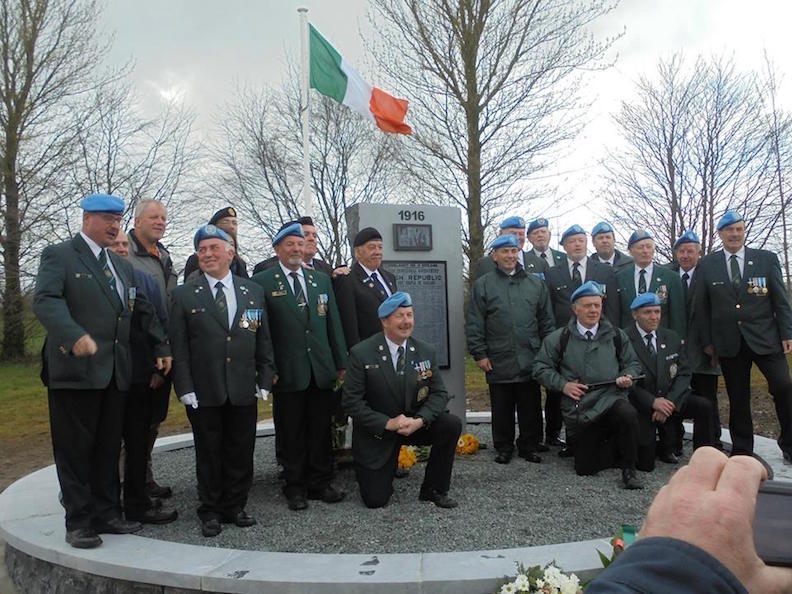
IUNVA Post 27 Portlaoise a site for all Veterans of the United Nations.  
The Irish United Nations Veterans Association(IUNVA) was formed at a meeting in Dublin on February 10th 1990, when an interim committee was formed.  The Association has the approval of the Minister of Defence, and is non-denominational, non-political and non-sectarian. Membership is available to any Irish resident who has successfully completed a tour of duty with a UN Force or Organisation, whether he or she is serving or retired. 


As veterans of U.N. operations world-wide IUNVA will continue to support our soldiers, Gardai and civilian personnel who serve in often dangerous and difficult circumstances. We hope that our country will also keep our traditions of service to peace in being.

We have contributed to over 50 years of peacekeeping with courage and tenacity. Our casualties have been many. Our dead are commemorated at Arbour Hill, and at other locations; but we must also remember the many who have been scarred, both physically and psychologically by their service overseas. We must continue to help these veterans and their families. That is why we were formed - let us not forget them.


Yours in peace,
________________________
Maj. Gen. (Retd.) V.F. Savino © with reference to http://iunvapost27.ie

We were very fortunate with weather and it was an occasion that will remain in the hearts and minds of all who attended. For myself, I would like to thank the Chair Mountmellick Monument Committee Brian Furlong for his kindness in reserving a chair for me in the marquee.


Noelle Geoghan representing Cumman na mBan


Badge of Cumman na mBan


Ruadhán MacEoin, the keynote speaker


Cathaoirleach Catherine Fitzgerald, Laois County Council


IUNVA Post 27 Portlaoise


Bill Lawlor MC of the event


Brian Furlong, chairman of the committee


Eugene Nolan played the whistle


The future generation looks on.