Tuesday, 9 May 2017

The Hill of Truth !

Our intention this time was to visit several places that Mrs. H has had her beady eye on for the past few weeks so at the weekend we set off on a round trip of two hundred and thirty-three miles. The weather was perfect, the coffee in the flask was strong and the road was ours.


Apart from visiting the places that were on our schedule, my navigation brought us to a small home that I had long heard about but had never seen. Finding it was a surprise and a treat for sore eyes.

Eamon De Valera’s home-place at Bruree in Co. Limerick. 


&


The Galtee Mountains
photo taken from Lattin in Co. Tipperary

The highest peak in the Galtee range is Galtymore which rises to 917 m (3,009 ft). Although not the highest mountain in Ireland it is very impressive and can be seen as a great backdrop on the skyline. Some of the best views can be found when approaching Cashel, Co.Tipperary from the north and onwards towards Tipperary Town. 
The Galtees are classified as having a High Fall risk for ramblers, with steep and dangerous areas as well as being very wet underfoot so great care must be taken when walking there.  


My favourite view of The Galtees

By mentioning The Galtee Mountains and Eamon De Valera it has brought to mind a song about a comrade-in-arms of his which I share with you here:

The song of the Galtee Mountain Boy


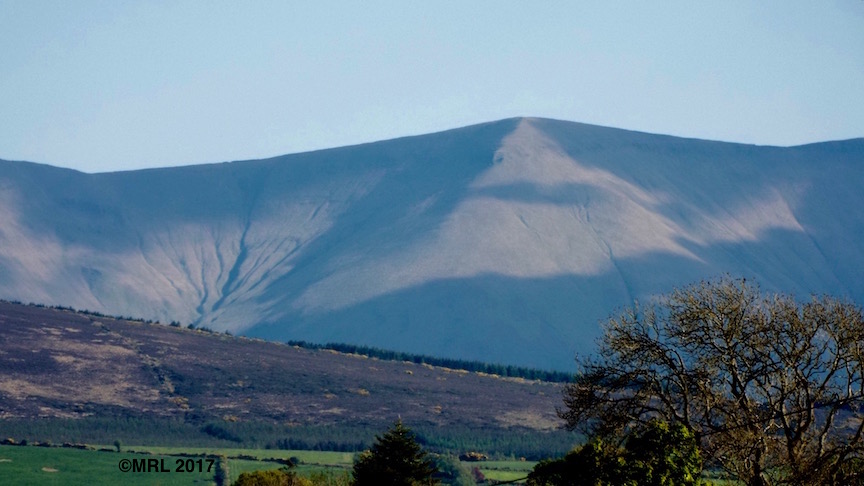
We continued along our route, travelling further south until we finally saw the outline of Cnoc Fírinne, Co. Limerick. Known as the Hill of Truth or of truthful prediction, because it serves as a weather glass to the people of the surrounding plains who can predict whether the day will be wet or dry by the appearance of the summit in the morning. It is here by tradition that the Irish God, Donn, has another home. 

The Hill of Truth

Cnoc Fírinne

I find it humorous that the male gods are more than likely to be found in the high places and associated with weather, death and truth, whilst their female counterparts are generally found lower in the landscape, in caves, valleys and rivers. 


On the drive home we both felt a bit weary and yet satiated from all that we had seen, the happy memories of which will remain with us. Thank you for visiting this blog and I hope you have enjoyed reading it as much as I have enjoyed sharing it.


Wednesday, 3 May 2017

TRANQUILITY RULES OK

DAWN SUNRISE


County Laois in April


A brackish lake in county Clare


Healing


Coastal Waters of Clare


The Offering


The Shannon in May


Tuesday, 4 April 2017

Curios of Counties Galway & Roscommon

Sunday 2nd April saw us once again on the road. This time our destination was to Drum in the south-west corner of County Roscommon and a good few kilometres from home. Fortunately the day held promise for the weather, when we left, was sunny and bright. Thankfully it stayed that way for the whole day.

Our route took us through the large town of Athlone  [Baile Átha Luain, meaning "town of Luan's ford]which sits astride the river Shannon like a mother duck. A good place for shopping with numerous stores that cater for everyone - ladies please note. We did not stop but pressed onwards through Monksland [Fearann na Manach] to Drum [Droim’ meaning ridge or hillock]. We followed the brown signposts towards the our destination - a megalith named Meehambee Dolmen, meaning yellow meadow from the Irish word Míothán buídhe. 
When the British Crown ruled Ireland they changed Irish names into what they thought were easily pronounceable place names. The consequence of this action was that the geographical meanings of  place names were obscured or lost and the Irish language was outlawed. Today we have English gobble de gook on some sign boards, though in places the original Irish is also displayed.


The Ice House

As we drove along a very narrow road that undulated and twisted left and right for several kilometres towards Míothánbuídhe, I noticed a rectangular hole in an embankment wall amid some stone heaps.  This suggested that we were passing a ruined building so we stopped and took photos. At home later my research told me that the hole was what is known as an Ice House where meats were preserved - rather like a fridge. The building is believed to be the former home place of the Ó Lionáin family, other names being O'Lennan, O'Lonain and both translate as Lennon.


A few minutes from the Ice House and we reached a small parking place. 
Here was the start of an old bridleway bordered by dry stone walls on either side, which looked to be very inviting. It proved to be a very pleasant stroll to the megalith, the majority of the plant life being fresh Ransom (Allium Ursinum), wild garlic in leaf, the scent of which faintly perfumed the air. On the way was a large hill fort known as Rath of the Wren which sadly it was fenced off, although I suppose doing so prevents it from being damaged.

Reduced headroom under a natural arch
of Whitethorn and Ivy


A blue fairy has just come out of the dolmen to take photo's !


Yours truly.


At the end of the bridlepath the Abhainn na Crannain
flows gently along

After our visit to the megalith we decided to make our way to Tuam in Co Galway for there is a particular Well there that Mrs H wanted to visit. Whenever time allows we always use the by-roads those whose designated number is preceded by an R or an L, rather than the large fast roads with a N or M. It is the scenery which interests us, that and the convenience of stopping for coffee and sandwiches which we always carry on tours such as these.


The bridge over the river Shevin at Ballinamore, Co. Galway.

Suddenly, I saw what appeared to be a castle wall in the distance complete with crenellations and yet there was no mention of this on the map. As we got closer I saw that it was a river bridge with a fortified high wall on one side only. Later research informed me that it was built in the mid 1800’s and I am guessing that it may well have been part of a famine relief scheme. Similar works were undertaken across the country, the idea being that money for food must be earned rather than given freely to those in need. 


We eventually arrived in Tuam, Tuim a burial mound, and although we knew the area where St Jarlaith’s well was situated we failed to locate it. So another journey must be undertaken armed with more detailed information. 
We turned for home with our route taking us through Athenry, Baile Áth na Ríogh, meaning "Town of the Ford of the Kings” and famed for the well-known song ‘The Fields of Athenry’.


The Dubliners-The Fields Of Athenry- HQ

  • 6 years ago
  • 1,229,282 views
The Dubliners--The Fields Of Athenry Lyrics By a lonely prison wall I heard a young girl calling Michael they are taking you 


Wednesday, 29 March 2017

The Cockerel, Mouse and Fly.

On Mother's Day we took ourselves off on an adventure to southern Laoise [pronounced as Leesh] and in particular to the picturesque village of Timahoe.

Timahoe, derives its’ name from Saint Tigh Mochua, 
there the houses are built around a large, central piece of common land known as the Goosegreen.  
St. Mochua established a monastery at Timahoe in the seventh century which burnt down in 1142, later it was re-established by the O’Moores.  
A 12th century round tower standing 96ft high is located close by Mochua’s Abbey and there was a monastic community here as late as 1650. It was then that the Franciscan friars were murdered at a spot known locally as "Boher a wurther" or the murdering road, by Colonel Hewson and Cromwell’s army. 

Along the road to Timahoe.

The locals call it 'Goosegreen'

Looking East the River Bauteogue

Looking West along the River Bauteogue

The round tower stands in a lovely setting accessed by a footbridge that crosses the River Bauteogue, Báiteóg, meaning ‘a swamp’. Originally access to the tower and Abbey was via a ford.


Drawing from Laois County Council archive
Detail of the towers entrance.


The Round Tower 
St Mochua had a reputation as a healer, and is said to have cured two other abbots – St Colman Elo of a sudden loss of memory and St Fintan Munnu of ‘leprosy’.
Mochua died in the year 657.

St. Mochua's companions


St. Mochua lived as a hermit without worldly goods except for three pets – a rooster, a mouse and a fly. The rooster wakened him for the hours of Matins; if he didn’t wake up or dozed off during the day weak from his vigils and prayers, the mouse would nibble at his ear not letting him sleep more than three hours a day or night. The fly would walk along each line of his Psalter as he read and when he became tired, the fly would stop at the point where the saint had broken off until he could return again to resume reading the Psalms.


The Little Pets of St. Mochua

When St. Mochua knelt to pray
Each morning at the break of day
There always was about the house
A rooster, fly and little mouse

Three willing slaves to serve him well
And share his solitary cell
The rooster every morn would crow
And waken him for matins, though
When he slept too sound to hear
The mouse came forth and nipped his ear

And though he never had a clock
The mouse would call him or the cock
And if he had to leave a book
From out some dusty hidden nook
A fly, with patience and with grace
Would sit for hours and mark the place.

 © John Irvine


I very much hope that your appetites have been whetted sufficiently enough to make a visit to this breath taking place. Where a on a sunny warm day you can lose yourself in peaceful surroundings and enjoy some wonder filled dreams.


Wednesday, 15 March 2017

To “A Road Across The Sea”

Last Sunday saw our first day trip of 2017. 
As usual the pull of the West and the sea took us to the coast. Now the weather forecast was not good and the temperature was in single figures, 8 deg C. It was overcast with fine rain, however experience has taught me that in Ireland forecasts are not that accurate because of the various factors involved, so we went off regardless. 
When we left the wind was blowing from the North-east and by the time we were half way it was from the South.


Our first stop was Portumna Forest Park where Toby (dog) and Mrs H stretched their legs and I opened up the picnic box for brunch and a cup of coffee. 
It was here that my eyes fell upon this delightful Silver Birch which seemed to glow in the sunlight.


The second stop was to photograph the flooded fields that lie in front of Lydacan Castle - Carnmore, Co. Galway.
Lydacan was an O'Heynes fortress in South Galway from the 14th century and Lydacan or Lydican Castle was the residence of the Lynch family in the 1770s. The Ordnance Survey records that the building was the “substantial residence of Mr. Gunning" in the 1830s. Lydacan Castle was purchased by Martin O'Flaherty in the mid-19th century and was subsequently sold by him to James Greated. It was burnt in 1922 and left in ruins. 

Our final destination, Traught Strand near Kinvara, in Co. Galway was reached and a chill wind blew strongly under a clear blue sky. After a brisk walk to watch the waves it felt good to be sitting in a wind proof vehicle, hot coffee in hand, looking out on the ever changing views of distant Connemara, Barna and Salthill.


The notice board reads:
“A Road Across The Sea”
Young St. Ciarán studied under St. Enda on the Aran Islands. 
Once ready to establish his own monastery, he and his monks travelled along a miraculous road which opened up on the seabed to Traught Beach.
Ciarán later travelled inland to the banks of the river Shannon in what is now County Offaly and founded Clonmacnoise, which became one of Irelands’ most famous seats of learning.

In the past pilgrims spent the eve of Garland Sunday praying besides St. Cairáns Bed behind the beach. In the morning the crawled on hands and knees to wash themselves in the sea before enjoying music, dancing, singing and boat racing.”


Here he is that bold young lad
St. Ciarán


On the horizon is Connemara

I love the ever changing colours of the sea.


Three brave and daring wind surfers entertained us oldies as we watched from the warmth and safety of our cars!


************************************************************************************
Finally before signing off I wish to draw your attention to 
Rescue 116 helicopter tragedy that took place off shore of Co Mayo
in the early hours of Tuesday morning.

Capt Dara Fitzpatrick, and her crew Mark Duffy, Ciarán Smith
and Paul Ormsby.
Were lost.
Please hold them and their families in your thoughts.


Monday, 27 February 2017

Gross Exploitation !

Today I received an email detailing the gross exploitation of  the Samsung workers which I now share with you all.


Dear Mel,

Help bring the hidden stories of Samsung’s supply chain workers to the Mobile World Congress, happening now in Barcelona.

When airlines banned the use of Samsung’s Note 7 after its fire-prone batteries started to spontaneously combust, the public got a sense of the fear that Samsung supply chain workers face on a daily basis. 

Because beneath Samsung’s shiny exterior as global electronics giant is a corporate culture that is callously geared towards maximising profit to the detriment of the everyday lives of its workers. It’s a modern tech company with medieval labor practices, whose calling cards are union busting, poverty wages, and insecure and unsafe work conditions. 

This week Samsung’s modern face is on full display at the Mobile World Congress in Barcelona, where tech industry giants are gathering to unveil the latest in smartphones, tablets and mobile tech. Who’s not invited to the glitzy convention? The largely invisible workforce of 1.5 million low-paid supply chain workers from across the globe who make Samsung products under precarious and sometimes deadly conditions. 

Join with us to help bring the stories of Samsung’s hidden workers to Mobile World Congress and the attention of the world’s tech elite. Share now.

It wouldn’t take much for Samsung treat their workers with dignity and pay a living wage. Our research shows Samsung makes $10,435 in profit for every supply chain worker -- meaning if they increased wages of $50 per month (just $600 per year) to reach a minimum living wage in Asia, they would still make $9,835 per worker. A tidy sum, even for a company so ruthlessly devoted to profit. 

For Hesty, who works in semiconductor production in Indonesia, a minimum wage on which she can live from Samsung would mean being able to pay for basics for her family such as clothes, food and childcare, without having to worry about whether her wages will last until the next pay day. 

Though Samsung would have to suffer very little to raise wages across its supply chain, its workers pay a huge price for the work they do: at least 79 workers have died of cancer related diseases after being exposed to chemicals used in the Samsung production process. And did the company take responsibility? Indeed not -- they refused to name the chemical that led to the deaths, citing trade secrets. 

It’s time Samsung and other tech giants acknowledged the true cost of modern tech by shedding their medieval practices. With all eyes on Samsung at the Mobile World Congress right now, your shares right now will have maximum impact. 


Thank you for all you do,

Sharan Burrow,
ITUC General Secretary.

supporter

Tuesday, 14 February 2017

A GAS TIME !

About month ago our twenty-three year old gas cooker finally gave up the ghost and died. It was no real surprise to us for the grill stopped working last year. We were not too bothered at the time because the oven and the top burners were still working efficiently. 
Sooner or later we would need a new cooker so we visited various retailers to find a good replacement.

In the middle of January we made our choice.
I particularly told the shop to ensure that the cooker was fitted with burner jets suitable for LPG  bottled gas (Butane) which is used here in the countryside as there is no piped gas supply.
I was informed that all of their cookers ran on ‘country gas’ and we arranged the delivery date.


The New Gas COOKER

The new cooker arrived, the defunct cooker was taken away to be scrapped and all that remained was to make the connection to the gas bottle. I had done this a great many times in the past and it had not been an obstacle.  I intended to do the same again, to the chagrin of the retailer, who said I needed a gas fitter to obtain a certificate. 

I competently made the connection without any leaks. Next job was to  the plug cooker into the electricity supply for the oven illumination and the six igniters.
Then came the first test, igniting the rings.
There were long yellow tips to the flames and the same phenomena also occurred in the oven.
Very clearly there was a problem. The burner jets were for the piped natural gas which is supplied to cities and towns.

Next morning I rang my supplier and informed him of my discovery. 
As I listened to his utter nonsense he tried to blind me with suggestions such as having fitted a bottle of ‘dirty gas’ which I totally refuted. Finally I was informed that the cooker had a kit with alternative burner jets, so I agreed to engage a Gas Fitter to replace them. 


 TOP OFF
The fitter arrived and then the real fun started. I don’t think he had ever changed burner jets before or even remove the various cooker parts, such as the top and front access panels. I ended up working alongside him, sometimes advising him on how to do his job. 


FRONT PANEL - OFF

Re-assembly was even more humorous than taking it apart. We did achieve a sense of order eventually and used all of the screws that we had removed without having any left over. 
Then came the first test. Yes, the four top rings had blue coloured flames, as did the oven.

BACK PANEL - OFF

We then ignited the grill. Damn and blast! 
The igniter worked, we could see it sparking. The gas was coming through, we could smell it. But no ignition, we had a banjaxed grill.
I said “ Xxxk it !..... Disconnect the xxxxing thing! ........ The retailer can have it back.”

Our gas fitter was with us for three and half hours, a job that should only have taken an hour.


One week later (last week) a replacement stove arrived along with the Gas Fitter.
More fun ensued, a lot more fun this time. There were gas leaks at the connection and he was mystified. I explained that at the pipe connection union, where there was a fibre washer it had a tapered thread and that it did not need any PTFE tape. So he stripped off the tape and guess what ?  No leakage of gas - Heron was right. I did though ask him for a certificate of worthiness and it is my belief that I had earned it!


Thursday, 6 October 2016

PORTUMNA PRIORY

Aerial view showing close proximity
of Castle and Priory.


Within the demesne of Portumna Castle exist, the ruins of Portumna Priory built around 1254. 
It was originally a Cistercian chapel, a sister house of the monastery at Dunbrody, Co Wexford. 
In 1426 the priory was taken over by the Dominicans when a papal indulgence was granted for its completion.
The Priory came under the patronage of the Earl of Clanricarde, de Burgo, in 1577 and contains the tomb of the Earl and his wife, although the location is unknown. 
During the Reformation the Priory was suppressed and then revived again in 1640.  
Eventually it was abandoned by the Friars when their numbers reduced to three in 1712 .  

After lying unused for fifty years Portumna Priory was taken over by the Anglican Church of Ireland until 1832 when they built their own church.


The Cloisters
 were partially restored in 1954 by the Office of Public Works.

The long shadows where monks once strolled


They stand as sentinels of a bygone age.


Under the splendid arches to the chancery window.


I felt nothing but a contemplative peacefulness as I strolled
around.


As with Portumna Castle, the ruins of the Priory are now a national monument.